
Samuel Sikazwe, Garden, Lusaka | 5 August 2026—Canadian procurement accounted for 33.0% of all Zambian exports in the first half of 2026. This volume outpaces second-placed China at 13.7%, firmly establishing Canada as the primary anchor for Zambian outbound trade. Refined copper almost entirely drives this demand. This concentration of capital flow highlights the structural dependencies defining global mineral supply chains. Canadian industrial buyers rely on Zambian base metals to feed their advanced manufacturing operations. Securing a third of a nation's export output requires immense financial and logistical coordination, translating to long-term commercial predictability for Zambian mining operators.
One Buyer Now Shapes the Direction of an Entire Trade Profile
No other country came close to matching Canada's share of Zambian exports during the first six months of 2026, according to the Zambia Statistics Agency's trade performance data. China followed at a distant second with 13.7%, meaning Canada's share alone exceeded the next two largest markets combined. Copper anodes made up 87.9% of everything Canada purchased from Zambia. This provides the clearest indication yet of how tightly the two economies have become linked through a single product line.
China's own purchases followed a similar pattern. These transactions were dominated by copper anodes as well, which accounted for 61.4% of its total Zambian imports. Switzerland rounded out the top five destinations, taking 9.5% of Zambia's exports. This was again driven primarily by copper, this time in cathode form. Three of Zambia's largest export partners are buying essentially the same underlying commodity in different processed states. These dynamic highlight the critical role Zambian output plays in satisfying global electrification and infrastructure demands.
Ms. Sheila S. Mudenda, Statistician General of the Zambia Statistics Agency, described the Agency's broader mission as extending beyond domestic policy.
"The Zambia Statistics Agency embarks on a vigorous information delivery strategy to major stakeholders and the media institutions," she stated.
This strategy promotes the understanding and use of official statistics both within and outside Zambia, securing international investor confidence. Foreign off-takers parsing these trade bulletins require precise data to structure their multi-year procurement contracts.
Congo DR Anchors a Different Export Story Altogether
Not every trade relationship in the bulletin runs through copper. The Democratic Republic of Congo emerged as the top destination for Zambia's non-traditional exports, taking 41.3% of that category. This movement is driven mainly by sulphur, a product used extensively in the neighbouring country's own mining sector. This regional trade sits apart from the copper-driven relationships with Canada, China, and Switzerland. It proves that Zambia's export profile carries meaningful diversity beneath its primary metal commodity.
Sulphur exports to the DRC highlight a growing intra-African industrial sector. As Congolese copper and cobalt operations expand, their demand for processing chemicals creates a lucrative secondary market for Zambian industrial suppliers. This cross-border dynamic builds a layer of economic resilience, insulating domestic trade revenues from the fluctuations of global base metal prices.
On the import side, sourcing patterns reveal a similarly concentrated picture. China led as Zambia's largest source of imports at 26.6%, with road tractors for semi-trailers standing out as a key product category. South Africa followed closely at 24.3%, supplying sulphur and diesel vehicles. Japan ranked third at 12.3%. Within that share, passenger vehicles exceeding 1,500 made up 69.8% of everything Zambia bought from the country.
Roads Carry the Weight That Ports and Rails Do Not
Getting Zambian exports to buyers as far away as Canada and Switzerland depends on one mode of transport. Road transport handled 95.8% of total export value in the first half of 2026, equivalent to K158.1 billion. Air transport carried just 2.2% of that value. Rail, despite being the mode traditionally associated with bulk mineral exports, accounted for only 0.8%, the smallest share of any transport category tracked in the bulletin.
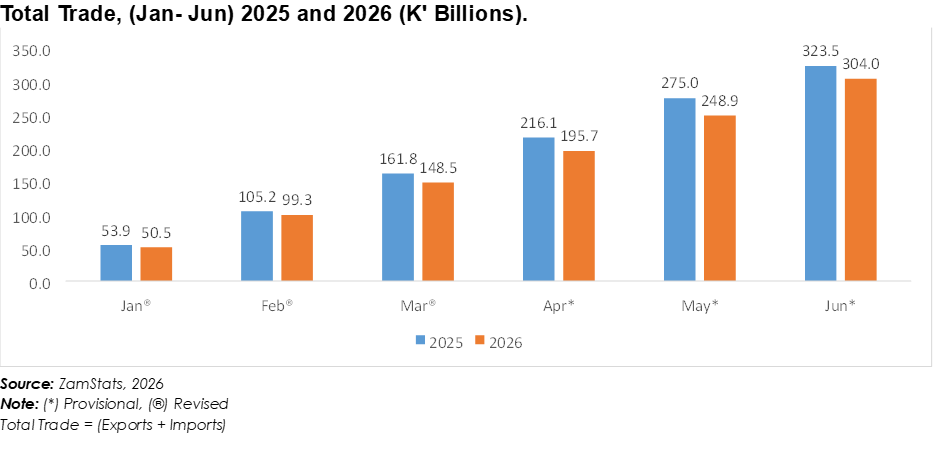
The dominance of road freight highlights a structural reality for mining operators. Capital-intensive fleets of heavy-duty trucks provide the agility and capacity required to move millions of tonnes of copper to coastal ports in Tanzania, South Africa, and Namibia. Imports followed a more balanced, road-dependent pattern. Road transport accounted for 53.2% of import value. Other multimodal transport methods carried a substantial 41.0% of the total import bill. Measured by volume instead of value, multimodal transport handled the majority of imports, moving 51.1% of the total 2.9 million metric tonnes brought into the country.
Ms. Mudenda framed the Agency's dissemination work as central to helping the public understand these specific logistical realities.
"This Monthly publication is an attempt to provide highlights of the work of the Agency," she noted, "and how it can help media institutions and the general public to improve understanding and uptake of statistical information for decision-making and sustainable national development."
These details shape how goods physically move in and out of the country. A logistics planner relying on this data can accurately forecast border congestion and allocate fleet resources to match the actual flow of national commerce.
A Landlocked Nation Building Global Reach
Zambia's position as a landlocked country makes the road transport figures particularly striking. Every consignment bound for Canada, China, or Switzerland must first cross at least one international border by road before reaching a port anywhere on the continent. In most cases, these goods cross several borders before reaching a coastline. That reality makes the 95.8% road transport share less a matter of preference and more a reflection of the infrastructure available.
Ms. Mudenda closed the Agency's foreword by pointing to the downstream uses the trade data serves beyond the bulletin itself.
"The information shared may be used for various purposes including... research," she added.
This highlights how trade statistics serve wider economic ambitions, allowing commercial planners to trace the physical movement of the national economy. Canada's 33.0% share, built almost entirely on copper anodes, will likely remain the defining feature of Zambia's export profile for some time. What the coming months may reveal is whether relationships like the one with the Democratic Republic of Congo, built on sulphur as an alternative to copper, can grow into a meaningful counterbalance. This regional expansion offers Zambia's trade book multiple directions to lean on, reinforcing the structural strength of the national economy.