KKKKKKKKKKKKKKKK.jpg)
South Africa’s cultural and sporting ambitions should travel first class in spirit, not necessarily in luggage. Amanda Michelle Mvinjelwa asks what R30.95 million at the FIFA World Cup says about public priorities when athletes crowd-fund, and a cancelled Venice pavilion leaves freedom of expression standing outside in the rain.
Amanda Michelle Mvinjelwa, Cape Town, South Africa | 23 JULY 2026—There are some phrases that arrive with a drumroll, a brass band and the unmistakable smell of a government motorcade. “Ons Baiza Nie” is one of them. We do not hesitate. We do not falter. We do not, apparently, consult the person with the calculator until after the boarding passes have been laminated.
Minister Gayton McKenzie’s department has defended R30.95 million in expenditure linked to South Africa’s 2026 FIFA World Cup programme. The spending was not, as the Minister rightly points out, R31 million for one man to sip imported water in a suite while the rest of us practise our concerned faces. The department says it covered a broader programme: travel, hospitality venues, match tickets, an exhibition match and activation spaces in Mexico City, Atlanta and Monterrey. It also says 151 people travelled, excluding a service-provider team, and that the Minister’s own costs were just over R1 million.1
That is an important correction. Accuracy matters, especially when public money is involved. But so does the question that refuses to sit quietly at the back of the hall: what does a country choose to make possible?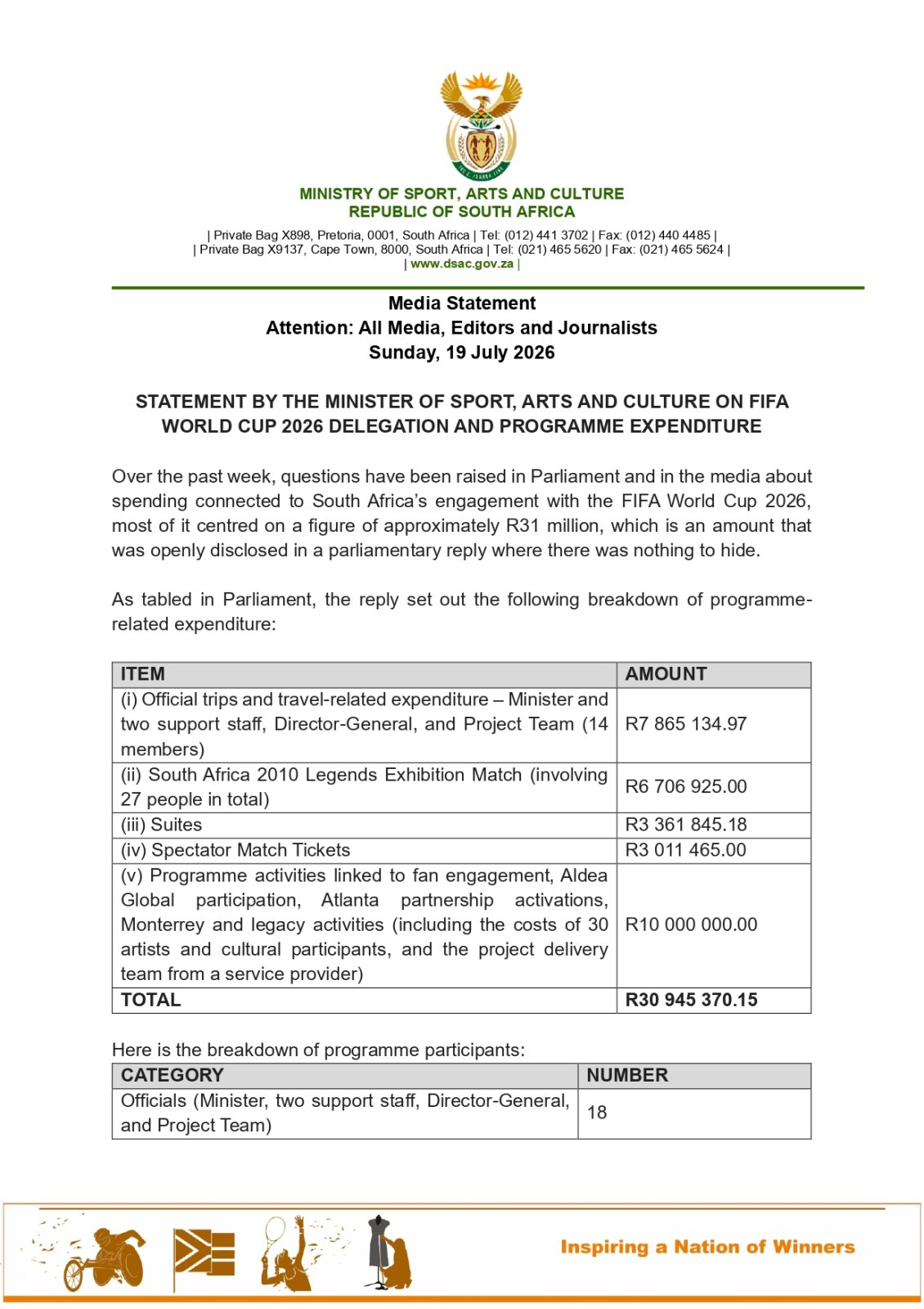
Departmental media statement supplied by the author: the disclosed expenditure total is R30,945,370.15. The debate is not whether a programme existed; it is whether its priorities meet the moment.
The suitcase has a budget; the dream has a BackaBuddy link
Let us take a respectful stroll through the ledger. The disclosed programme includes R7.86 million for official travel-related expenditure, R6.71 million for the South Africa 2010 Legends programme, R3.36 million for hospitality venues, R3.01 million for 294 FIFA tickets, and R10 million for South Africa’s physical presence at the tournament.1 These may be legitimate categories of nation-branding. Countries do build relationships. Sport does create commerce. A good exhibition can be an economic handshake with better lighting.
“People don’t organise an international programme on Zoom. You need the right people on the ground.”Gayton McKenzie, defending the delegation expenditure.1
Fair enough. But neither does a young athlete organise a World Championship campaign on hope, two fundraising posts and a prayer that an airline will accept an emotional-support kitbag as excess baggage. The uncomfortable contrast is not that government spent money on an international programme. It is that many athletes and grassroots teams routinely seek public help for travel, visas, accommodation and kit. The national instinct must not become: “Our flag flies proudly abroad, provided the athlete has Wi-Fi and a crowdfunding page.”
The receipt, without the smoke machine
• R30.95 million: reported total departmental expenditure on the FIFA World Cup programme.1
• 151 people: reported number sent to Mexico and the United States, excluding the service-provider team.1
• R1.05 million: the Minister’s stated personal travel-related cost.1
• The unresolved public question: whether the same urgency is visibly reaching athletes and artists who represent SouthAfrica without a departmental travel ecosystem.
Venice, where the pavilion became an empty sentence
Then came Venice — the place where art normally speaks in a hundred accents and every nation tries very hard not to look like it brought its cultural policy in a plastic bag. South Africa withdrew its 2026 Venice Biennale pavilion after Minister McKenzie objected to the planned work by artist Gabrielle Goliath, describing its subject matter as “highly divisive” and raising concerns about foreign influence. Goliath, curator Ingrid Masondo and studio manager James Macdonald went to court seeking reinstatement of the pavilion.2
Precision matters here too. The reported legal challenge was brought by Gabrielle Goliath, together with curator Ingrid Masondo and studio manager James Macdonald. Their case reaches beyond one exhibition: what happens when a national platform for artistic expression is withdrawn just as South African work is ready to meet the world?
And self-funding cannot become South Africa’s unofficial arts policy. For every artist able to marshal private resources, networks or personal savings, there are many gifted artists who may have had the vision for Venice but not the airfare, freight costs, accommodation or financial cushion required to finance their own rescue. We may never know which sculptor, photographer, performer or filmmaker remained at home while an empty national pavilion occupied the space where opportunity should have stood. Talent should determine who reaches the world stage — not the depth of an artist’s pocket.
The supplied press screenshot identifies the reported legal challenge by Gabrielle Goliath, curator Ingrid Masondo and studio manager James Macdonald over the withdrawn Venice pavilion.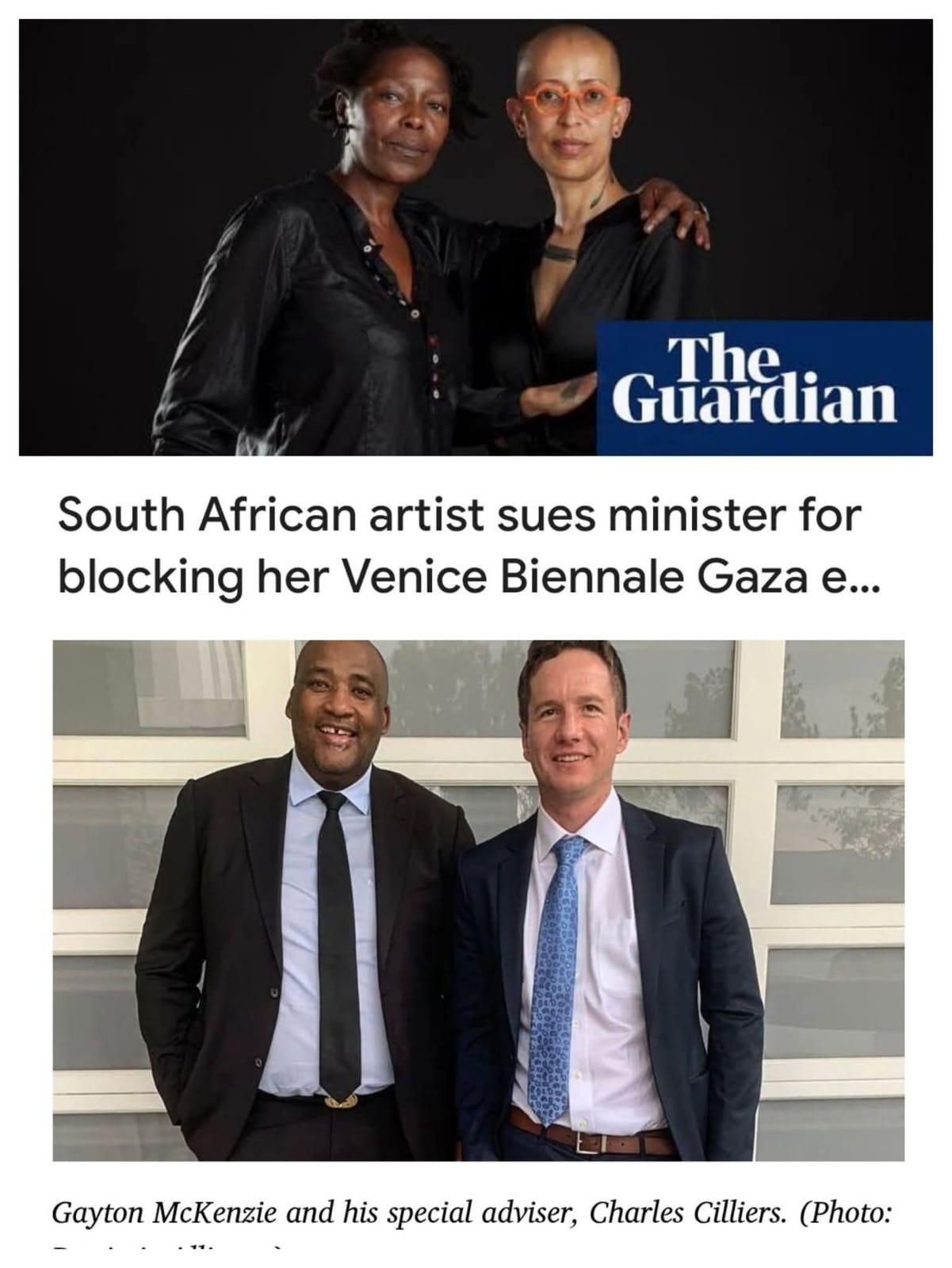
“The subject matter, as outlined, is known to be highly divisive in nature and is related to an ongoing international conflict that is widely polarising.”Gayton McKenzie, in a letter quoted by The Guardian.2
Of course art can be divisive. So can a protest song, a documentary, a freedom charter, a kitchen-table conversation, and a family WhatsApp group after somebody forwards a voice note about politics. Division is not automatically a defect; sometimes it is the sound made when a society meets a truth it has been avoiding.
Freedom of expression is not a decorative frame that government takes down when the artwork becomes inconvenient. It is the wall. It is the floor. It is the slightly uncomfortable chair on which democracy asks us to sit properly. We may disagree with an artist, debate the work, interrogate its politics and even decline to applaud. But a cultural ministry ought to be extremely careful when it confuses discomfort with danger.
A nation is not built in the VIP suite alone
Sport is the most democratic thing we own. On a field, a track, a court or a pool deck, South Africans become briefly and gloriously ungovernable by category. We shout for the runner who has no surname on a billboard. We hold our breath for the goalkeeper. We become experts in hockey, swimming and 400-metre splits with the confidence of people who have never completed a warm-up.
That is why the funding question lands so heavily. Sport is not merely a tourism brochure with better calves. The arts are not merely a backdrop for receptions. They are how we understand ourselves before somebody else decides to explain us. They need early investment, transparent criteria, fair access and a public posture that says: if you carry South Africa on your shoulders, the state will not leave you carrying the invoice too.
Minister, this is not a request for pageantry to disappear. It is a request for priorities to look less like a red-carpet guest list and more like a national development plan. Publish the selection criteria. Show the pathways from township pitch to international competition. Show the support from studio floor to global biennale. Let the public see how talent is nurtured before it becomes an emergency fundraiser with a motivational caption.
Hayini, let us ask the asked
So here are the asked questions, Minister — the ones with the uncomfortable little commas:
Can a department say it is building a nation of winners while athletes continue to raise travel money in public? Can a ministry safeguard South African culture while an official Venice pavilion becomes a symbol of retreat? Can “Ons Baiza Nie” mean more than not hesitating to spend — can it mean not hesitating to back the unknown runner, the young swimmer, the rural theatre-maker, the photographer whose work makes a powerful person sigh into a microphone?
I do not regret expecting better. I regret that expecting better can sound, in our political weather, like an extravagant request. The arts are our archive of freedom. Sport is our rehearsal for unity. Neither should have to audition for dignity after the airport lounge has been booked.
About the Author
Amanda Michelle Mvinjelwa is a Cape Town-based writer, speaker, interviewer, panel moderator, business-development consultant and project strategist. A Certified Professional Director and Accredited Chairperson, she brings more than two decades of leadership experience across aviation, hospitality, customer experience, humanitarian strategy and enterprise development.
Her writing is interested in the places where policy meets ordinary people: the athlete who has talent but no travel budget, the artist who has a voice but no platform, and the public institution asked to account for both its money and its mandate. Amanda writes with a distinctly South African, Pan-African lens — direct, curious and unwilling to confuse ceremony with delivery.
She is the author of The Woman Who Refused to Give Up, a leadership memoir and practical reflection on resilience, purposeful ambition and refusing to be defined by circumstance. When she is not writing or moderating a conversation, she is likely to be building partnerships, advocating for opportunity, or preparing for another long-distance run.