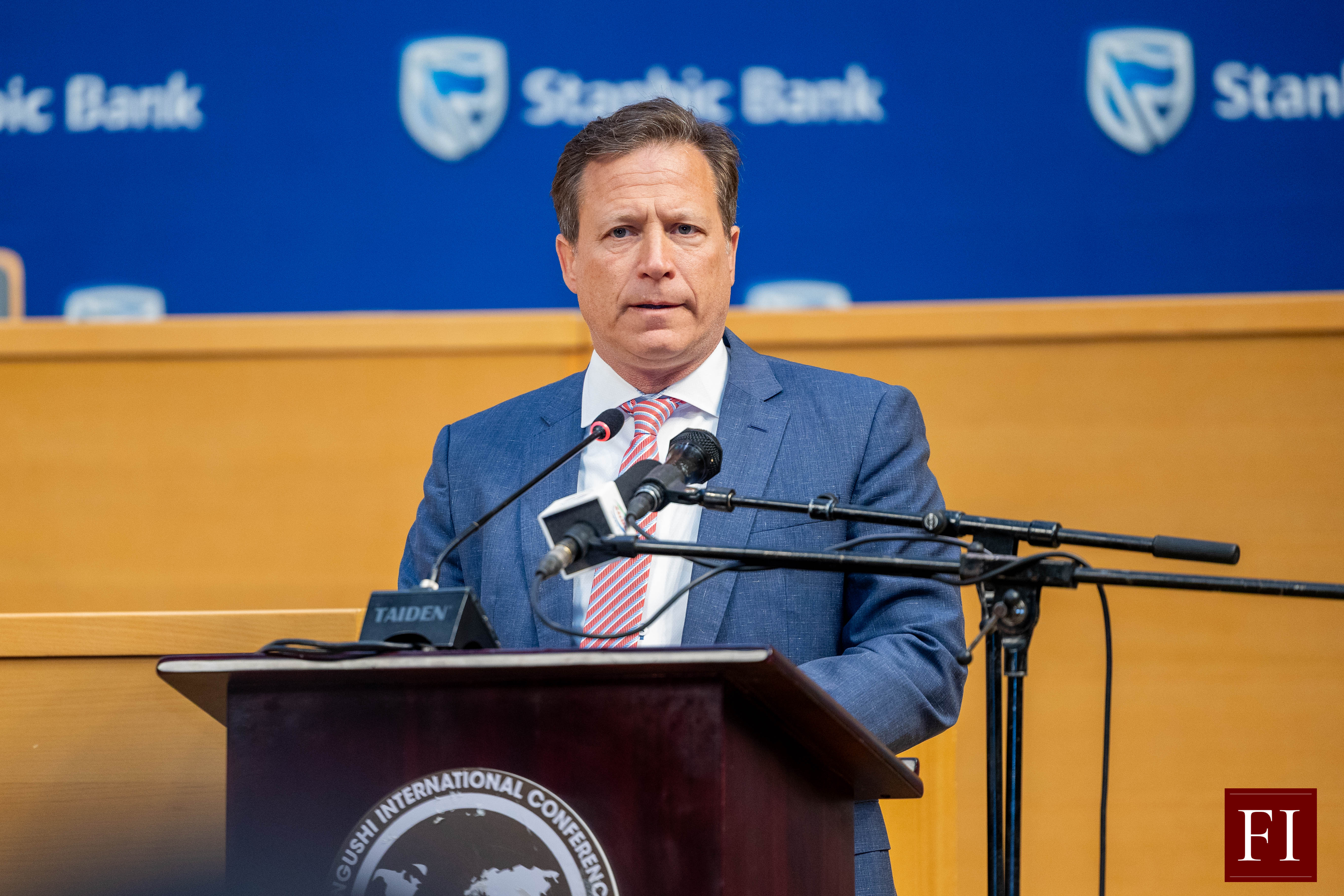
Mozel Chimuka, Mulungushi Conference centre, Lusaka, 10 September – In rural villages across Africa, children squint over textbooks by candlelight, mothers walk miles to charge mobile phones, and small businesses close at sunset—not by choice, but because 600 million people live without reliable electricity. Andrew Herscowitz, CEO of Mission 300 Accelerator, has seen these realities firsthand, and his response is audacious: deliver power to 300 million Africans by 2030, backed by half a billion dollars in funding and a simple philosophy that every energy solution must create jobs, jobs, and more jobs. Thus, the accelerator, led by Mr. Andrew Herscowitz, CEO, has risen to meet this reality.
"The reason I emphasise accelerator," says Mr. Herscowitz, "Is that everybody in this room is an accelerator to make sure that we achieve the goals of Mission 300, and the number one accelerator in Zambia is His Excellency."
Speaking at the Energy Forum for Africa Conference in Lusaka, Mr. Herscowitz outlined an ambitious programme backed by $500 million in committed funding from the Rockefeller Foundation and key development partners. The Mission 300 initiative places employment generation at its core. “Mission 300 is 100% about jobs, jobs, and jobs” Mr. Herscowitz highlighted. The programme aims to ensure that energy constraints do not limit Africa's anticipated rapid growth throughout this century, focusing on both large-scale generation for economic development and affordable access for underserved communities. The initiative builds on lessons learned from Power Africa, which took 11 years to help 200 million people across Africa gain access to electricity, primarily through Pico Solar solutions.
Mission 300 operates under the leadership of the World Bank and African Development Bank, with crucial support from the Rockefeller Foundation, Sustainable Energy for All, and the Global Energy Alliance for People and Planet. This partnership structure provides the glue and grease to fill funding gaps that traditional public sector financing and commercial banks cannot address.
Mr. Herscowitz noted the evolution of business models since the launch of Power Africa 11 years ago, bringing to light how today's approaches offer more sophisticated solutions for both on-grid and off-grid energy challenges.
The Rockefeller Foundation and partners have already committed $500 million strategically allocated across multiple intervention areas to support the Mission's objectives. A $10 million allocation focuses on technical assistance programmes currently being implemented across Africa, including specific work in Zambia on upgrading electricity legislation and mini-grid frameworks.
"The goal is to try to support the rapid scaling of off-grid energy companies, particularly in the mini-grid space," stated Herscowitz. In supporting this agenda, an additional $10 million has been contributed to a $300 million facility managed by the International Finance Corporation (IFC), designed to support the rapid scaling of off-grid energy companies. This facility aims to help mini-grid developers move beyond deploying five or ten projects annually to rolling out hundreds or thousands of mini-grids each year.
The Mission 300 leadership expressed confidence that the 2030 target is achievable, citing an existing pipeline of projects that, if kept on track and expedited, will meet the ambitious goals. Mr. Herscowitz suggested the initiative might even exceed its targets given current momentum and partnership commitments.
Addressing conference participants, Mr. Herscowitz urged everyone present to serve as proponents for Mission 300 objectives. He fervently said, “The challenge involves amending bureaucratic timelines so that processes take a week instead of a month, a month instead of six months. This mindset applies to both Zambia's national energy compact goals and the broader continental Mission 300 objectives.”
With strong commitments from development finance institutions, innovative private sector partners like Africa GreenCo, and committed political leadership demonstrated by President Hichilema, Mission 300 represents a new generation of African energy access programmes.
"When I leave here and people say to me, where should I be investing?" Mr. Herscowitz asked, "My first response 100% is going to be Zambia. I'm really encouraged by what we're seeing here." Indicating that Zambia's commitment to both large-scale projects and off-grid solutions, its collaborative spirit, and its focus on accelerating progress make it an example for other African nations. It demonstrates that with the right leadership and a clear vision, the challenge of energy poverty can be overcome, but with a true sense of purpose. The Mission 300 initiative isn't just a number; it's a testament to the idea that by working together, the global community can help Africa power its own prosperity.