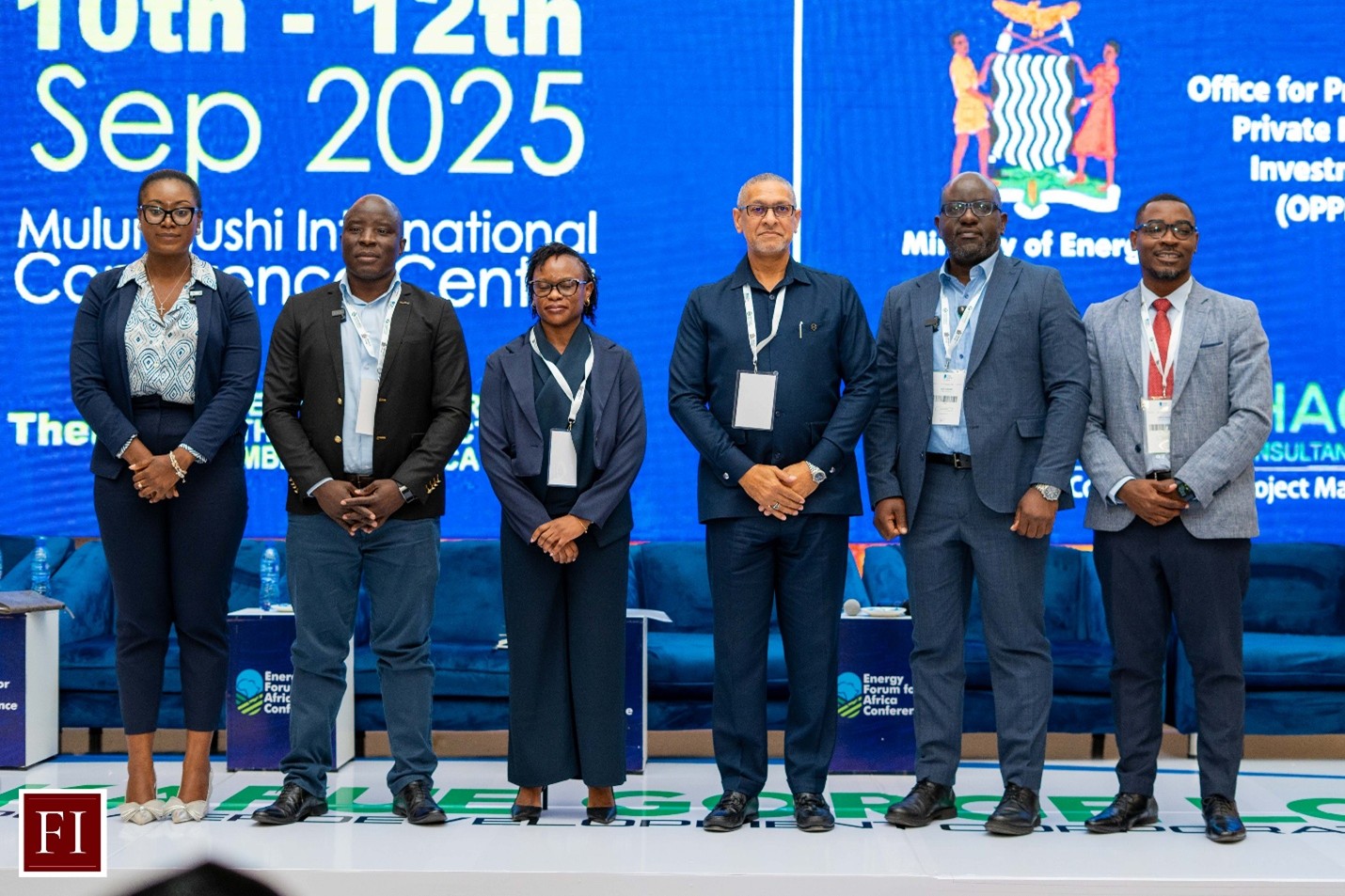
Esther Nachula, Mulungushi Conference Centre, Lusaka, 11 September, 2025 — While most African nations debate their energy futures in conference rooms, Zambia's crews are already pouring concrete. Solar farms rise from remote villages, massive dams take shape across international borders, and a quiet revolution unfolds at construction sites most people will never see.
The main hall at Mulungushi Conference Centre susurrated with the kind of focused energy that comes when big plans start becoming reality. Representatives from across Zambia's energy sector had gathered for the Energy Forum For Africa 2025, each carrying updates on projects that collectively represent the country's most ambitious push toward energy independence.
The numbers tell a compelling story. Zambia's energy demand will surge from 2,400 megawatts today to 11,000 megawatts by 2050. Meeting that challenge requires incremental improvement and demands the kind of visionary thinking that was on full display during the panel presentations.
The Solar Explosion Gains Momentum
Tom Daka, a regional manager at ZESCO and project manager at ZIZABONA, delivered perhaps the most tangible progress report. His company has moved well beyond planning phases, with construction crews already working on multiple sites. The Serenje solar facility, a 25-megawatt installation, reached full operation in June 2025. Workers at the 50-megawatt Mansa project have pushed completion to 60 percent, with commercial operation scheduled for December.
"We're creating what we call green cities, hybrid solutions that pair solar generation with battery storage," Dakar explained to the audience. “These projects span various development stages, most targeting completion before year-end.”
The scale becomes clear when considering ZESCO's net metering program alone has already connected 251 domestic customers, representing 11 megawatts of distributed solar capacity. Each rooftop installation might seem small individually, but together they demonstrate how the presidential 1000-megawatt solar directive is taking hold at every level.
Hybrid Thinking Reshapes Energy Strategy
Mr. Evaristo Katongo from Lunsemfwa Hydro Power Company brought a different perspective to the discussion. His company has been quietly developing what might become the template for Zambia's energy future: seamless integration between solar and hydroelectric generation.
"We started this work before the presidential directive was announced," Mr. Katongo noted. "Our 27-megawatt solar installation operates in conjunction with our existing hydro facility. We're proving the concept works."
The proof of concept matters because Lunsemfwa has much larger plans. Their Muchinga Power Company site could support 260 megawatts of hydroelectric capacity alongside 135 megawatts of solar. The hybrid approach addresses a critical challenge which is providing reliable baseload power while maximising renewable energy output.
Ground preparation work has already begun at the 27-megawatt site, with an official ground-breaking ceremony scheduled for September 24, 2025. "Every drop counts," Mr. Katongo emphasised, referring to their climate-adaptive approach that treats water resources as precious while solar energy fills the gaps.
Private Sector Finds Strategic Openings
Northwestern Energy's presentation revealed how private companies are identifying market opportunities within the broader national strategy. Limbikani Lungu, the company's finance manager, described their 60-megawatt Kalumbila solar project as a study in strategic positioning.
"We're already a distribution company with existing customers," Lungu explained. "Twenty megawatts of our planned capacity already has dedicated off-takers lined up." The project sits in the heart of mining country, where industrial customers provide the kind of steady demand that makes financing straightforward.
The location offers additional advantages. The same substation that handles the interconnector to the Democratic Republic of Congo will carry power from Northwestern's solar plant, creating export opportunities for excess generation. Construction begins before year-end, with completion targeted for ten months, matching the efficiency timeline set by other recent presidential priority projects.
Community Leadership Drives Rural Development
Perhaps the most striking presentation came from Mr. Justin Chongo, representing the Chitoshi Solar project in Lunte District, Northern Province. His project demonstrates how traditional leadership and community organisation can drive large-scale renewable energy development in remote areas.
"We're 1,000 kilometres from where we're sitting today," Mr. Chongo told the audience. "But we've secured 708 hectares of land from traditional authorities, completed our environmental clearances, and we're at about 60% project completion."
The numbers behind Chitoshi Solar reveal both opportunity and constraint. The Ministry of Energy granted feasibility rights for 200 megawatts, but transmission limitations mean the first phase will deliver 100 megawatts. The project site sits just 1.5 kilometres from existing grid infrastructure, minimising connection costs.
Chongo's presentation highlighted a recurring theme throughout the conference: balancing ambition with infrastructure reality. "We've done the technical feasibility studies, completed the financial modeling, and we're finalising our power purchase agreement," he said. "But the open access policy needs to move from paper to practice if we're going to attract the financing these projects require."
The Batoka Vision Anchors Regional Ambitions
While solar projects capture immediate attention, Ms. Relent Ncube from the Zambezi River Authority presented the longer-term anchor for regional energy strategy: the Batoka Gorge Hydroelectric Scheme. At 2,400 megawatts, Batoka represents the largest single addition to Southern Africa's power generation capacity.
The project carries significance beyond its size. Early concerns about environmental impact on the UNESCO World Heritage site have been resolved through extensive consultation. What initially appeared as a major obstacle transformed into an opportunity, Batoka will serve as a pilot project demonstrating how large-scale development can proceed alongside conservation.
"The sustainable development program adopted in Paris this year positions Batoka as a case study," Ncube explained. "We're showing that renewable energy development and environmental protection can advance together."
The financing structure reflects careful balancing between public strategic interests and private sector efficiency. Public entities will hold majority stakes in dam infrastructure, while private partners take the lead on power generation facilities. The Resource Mobilisation Committee, drawing membership from finance and energy ministries in both Zambia and Zimbabwe, oversees public equity contributions.
Infrastructure Reality Shapes Project Timelines
Every presenter acknowledged the same fundamental challenge, how transmission infrastructure determines what projects can deliver power to customers, shaping the reality of project design across the sector.
Chitoshi Solar split their development into phases based on grid evacuation capacity. Northwestern Energy chose their site partly because existing infrastructure could handle their output. Even ZESCO's distributed approach through net metering reflects recognition that multiple smaller connections might prove more efficient than fewer large installations in areas lacking transmission capacity.
The constraint has pushed companies toward creative solutions. Hybrid projects like Lunsemfwa solar-hydro combination make better use of existing transmission lines. Battery storage systems allow solar installations to provide baseload power that matches grid requirements.
Matching Ambition with Financing Models
As is often the case, financing was the biggest elephant in the room, presenting challenges and opportunity alike. Traditional project finance depends on predictable cash flows, typically delivered through long-term power purchase agreements with creditworthy off-takers. Some companies are securing dedicated customers even before construction begins, while utility-owned generation models avoid off-taker risk entirely. Community-driven projects often utilise complex financing structures but can access different funding sources. The broader policy environment continues adapting to support these varied approaches, with cost-reflective tariffs, open access regulations, and standardised power purchase agreement terms forming the necessary foundations for scaling up development.