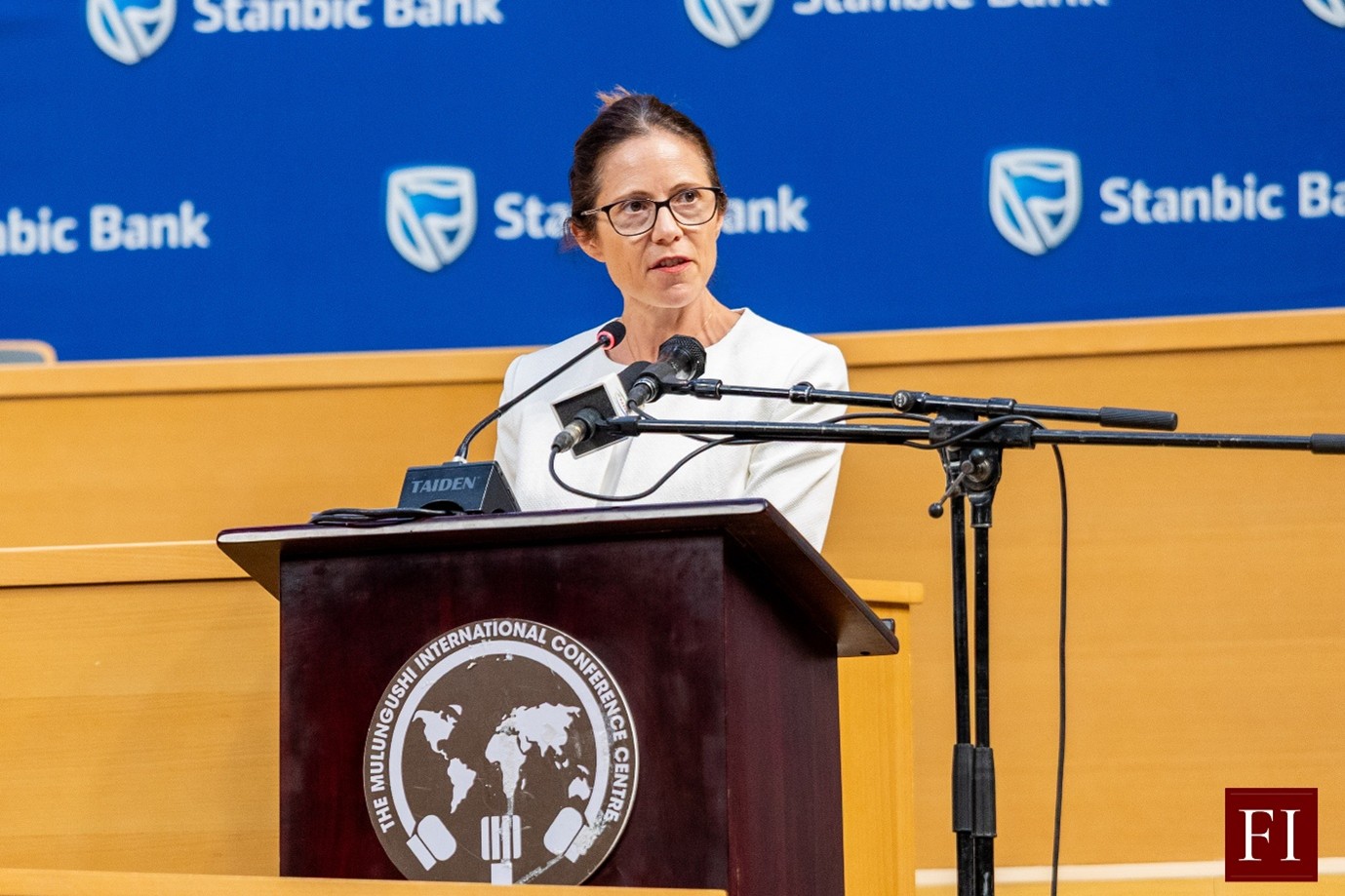
Esther Nachula, Mulungushi Conference Centre, Lusaka, 10 September 2025 — Eighteen months. That's how long it took Solar Century Africa to turn dirt into electricity in Zambia—a timeline that would have been impossible just a few years ago when bureaucratic mazes stretched project approvals into multi-year odysseys. Today, British companies are writing $200 million worth of checks to back Zambia's reformed energy market, and the speed of their success is rewriting the rules for African infrastructure investment. Speaking at the 2025 EEFA conference in Lusaka, Rebecca Terzeon, British High commissioner to Zambia, outlined nearly $200 million in active investments while highlighting how Zambia's regulatory reforms have created one of Africa's most attractive power markets.
The partnership represents a dramatic validation of President Hichilema's reform agenda, with British firms and institutions leading major projects across generation, distribution, and rural electrification. From concept-to-production timelines slashed to 18 months to innovative financing models reaching 300,000 rural households, the UK-Zambia collaboration is delivering tangible results that extend far beyond diplomatic rhetoric.
Regulatory Revolution Attracts Major Investment
The transformation of Zambia's energy sector has created what Rebecca Terzeon described as a "transparent, rules-based electricity market" that is attracting unprecedented private investment. The shift from case-by-case decision-making to standardized processes has fundamentally altered investor confidence, with British firms now viewing Zambia as a regional gateway for energy development.
"Zambia's power sector reforms anchored in the open access mechanism and the creation of an independent system and market operator for the grid are laying the foundation for a transparent rules-based electricity market," she explained to the conference attendees. The reforms work "by replacing case-by-case decisions with clear processes for grid access, capacity allocation, implementation and payment," she said.
Central to this transformation is Zambia's open access mechanism and the creation of an independent system and market operator for the national grid. These reforms have replaced arbitrary bureaucratic processes with clear procedures for grid access, capacity allocation, and payment systems. The result is a competitive environment that enables responsible private sector investment while safeguarding the financial viability of state utility Zesco.
Terzeon noted that Zambia is "deconflicting stakeholder incentives in the transmission sector and paving the way for inclusive growth." She emphasized that "these reforms are already bearing fruit by signalling an attractive investment market and one that is open to trading regionally."
The UK's technical assistance, delivered through CIG Zambia and other partners, has been instrumental in implementing these market structures. Working hand-in-glove with the Zambian government, British advisors are helping execute the country's integrated resource plan for the power sector, which maps out national electricity needs through 2030.
British Firms Lead Generation Expansion
Solar Century Africa, a UK firm, exemplifies the new investment climate's potential. In collaboration with Zesco, the company achieved a remarkable milestone by taking its 25-megawatt Milo Phase 1 project from concept to production in just 18 months, electrifying the facility in July 2024. The company's success story continues with plans to bring an additional 90 megawatts online within the next year, representing nearly $100 million in private investment.
This rapid project delivery demonstrates how Zambia's reformed regulatory environment can compete with global standards. The 18-month timeline stands in stark contrast to the previous system, where similar projects required years of bureaucratic navigation before reaching operational status.
Global EC, jointly owned by British International Investment and Norway's NOR Fund, represents an even larger commitment to Zambia's energy future. The company is spearheading development of over 400 megawatts of solar and wind projects across the country, positioning itself as a major player in Zambia's renewable energy expansion.
In June, Global EC demonstrated confidence in Zambia's diversified energy portfolio by signing a share purchase agreement to acquire a majority stake in Lumfer Hydro Power Company, which owns and operates 56 megawatts of hydrogeneration capacity. This month, the company will break ground on a new 27-megawatt solar project at Lan Sen, adding another milestone to Zambia's renewable energy journey.
Trading Revolution Creates Regional Opportunities
The reform program has unlocked regional electricity trading opportunities that were previously impossible under Zambia's rigid regulatory framework. UK seed funding helped establish Africa Green Co, which has emerged as one of the region's most innovative power trading companies, capitalizing on cross-border electricity commerce opportunities.
"We've seen a growth in energy trading with UK seed funding," Terzeon told the gathering, highlighting how "Africa Green Co has emerged as one of the region's most innovative power trading companies." She noted the significance of having energy ministers from neighbouring countries present, saying "we have honourable ministers from Mozambique and Botswana here" to witness Zambia's transformation.
This trading capacity addresses a critical inefficiency highlighted by President Hichilema, where neighbouring countries with electricity surpluses cannot easily sell power to deficit markets due to regulatory and infrastructure constraints. The UK-supported reforms are creating the market mechanisms necessary for efficient regional energy distribution.
The presence of energy ministers from Mozambique and Botswana at the conference underscores the regional significance of Zambia's transformation. As these countries observe Zambia's success in attracting private investment and accelerating project delivery, the reforms could catalyse similar transformations across Southern Africa.
Grid Infrastructure Unlocks Rural Access
While generation expansion captures headlines, the UK partnership recognizes that grid infrastructure represents the next critical frontier for sustainable energy development. Traditional government-funded approaches to transmission and distribution infrastructure are being supplemented by innovative private sector models that blend commercial and concessional capital.
Grid Works Development Partners, backed by British International Investment, exemplifies this approach through its support for Anzana Electric Group, a joint venture with Zesco focused on rural electrification. The partnership aims to deliver first-time grid connections to 40,000 households in Northwestern Province over the next two years.
Anzana's ambition extends well beyond this initial target, with plans to reach 300,000 households by 2030 through mobilized blended financing. This rural electrification program demonstrates how reformed market structures can address inclusive development challenges while maintaining commercial viability.
The initiative addresses a critical gap in Zambia's electrification strategy, ensuring that energy access extends beyond industrial and urban centres to rural communities that have historically been underserved. By combining commercial investment with development finance, the model creates sustainable pathways for universal energy access.
Financial Innovation Drives Scalability
The UK partnership highlights how innovative financing models are essential for scaling energy infrastructure in developing markets. Traditional approaches that rely exclusively on government funding cannot generate the capital required for universal energy access, making private sector engagement crucial for achieving national development goals.
"As generation expands, the next frontier is unlocking investment in grid infrastructure, especially to accommodate variable renewable energy," Terzeon explained. She emphasized that "transparent pricing and innovative financing models for grid transmission and distribution are essential to attract private capital to a sector that has traditionally been government funded."
The High Commissioner highlighted the ambitious rural electrification goals, noting that Anzana's "ambition is to reach 300,000 households by 2030 through mobilizing a blend of commercial and concessional capital." She described this as "rural electrification, inclusive electricity provision happening as we speak."
British International Investment's involvement across multiple projects demonstrates institutional confidence in Zambia's reformed market structures. The institution's backing provides credibility that attracts additional private capital while reducing investment risks through its development finance expertise.
Transparent pricing mechanisms and clear regulatory frameworks have been essential for attracting this private capital to sectors traditionally dominated by government investment. The UK experience in Zambia suggests that well-designed reforms can unlock private finance for public infrastructure challenges.
Regional Model for Energy Transformation
The UK-Zambia partnership is creating a replicable model for energy sector transformation across Africa. By demonstrating that regulatory reform can attract significant private investment while maintaining public service objectives, Zambia is establishing itself as a regional leader in energy market development.
The success stories emerging from this partnership provide concrete evidence that African energy markets can compete globally for private capital when supported by appropriate policy frameworks. With British firms delivering projects on international timelines and achieving commercial returns, Zambia is proving that African energy investments can meet global institutional investor standards.
As the partnership continues expanding through 2030, its impact extends beyond Zambia's borders, creating demonstration effects that could accelerate similar reforms across the continent. The UK's commitment to supporting transparent, competitive markets while achieving development outcomes offers a pathway for sustainable energy transformation that other African countries can adapt to their specific contexts.
The nearly $200 million in current UK investments represents just the beginning of what reformed energy markets can achieve when political will combines with appropriate regulatory frameworks and international partnership.