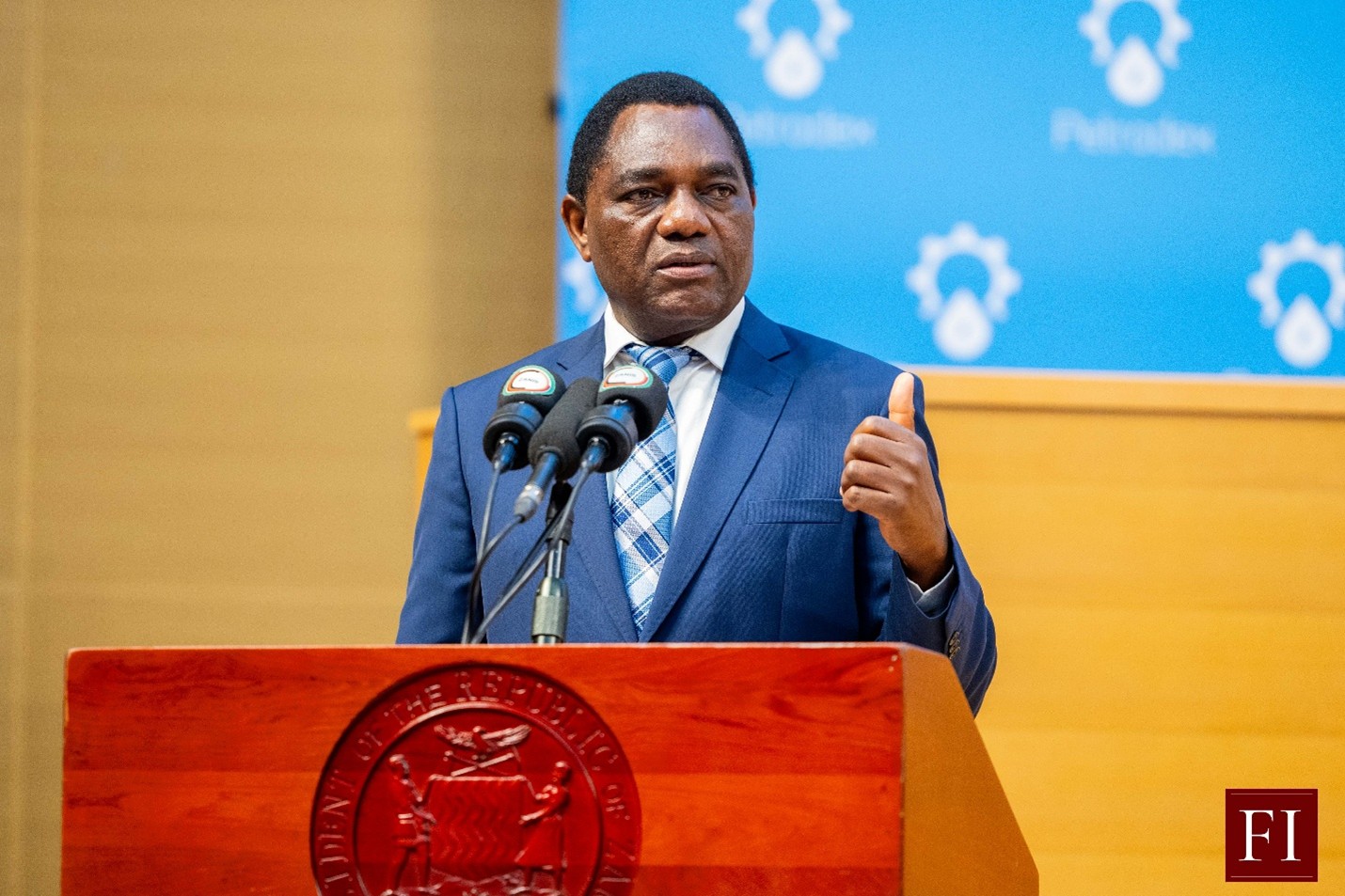
Esther Nachula, Mulungushi Conference Centre, Lusaka, 10 September 2025 — African leaders are done asking politely for electricity – they're demanding it for all 1.5 billion people, and one president just showed exactly how to make it happen in 48 hours instead of 25 months. President Hakainde Hichilema delivered a bold call to action at the 2025 EEFA Conference in Lusaka, challenging the continent to abandon limited energy targets and instead pursue universal electricity access for all 1.5 billion Africans. Speaking at the Mulungushi Conference Centre, he outlined dramatic reforms that have transformed his country's energy sector while urging regional integration and fair treatment from global investors.
The second edition of the forum brought together energy ministers from across the region, including representatives from Mozambique and Botswana, diplomats, and officials from the Rockefeller Foundation and Mission 300 initiative. However, President Hichilema used the platform to question the scope of current continental energy ambitions.
Beyond Mission 300’s Limited Vision
In a striking departure from conventional energy discourse, President Hichilema criticised Mission 300’s goal of providing electricity to 300 million Africans as fundamentally inadequate. “The population of Africa is well above 1.3, north of 1.5 billion people. So this agenda is too narrow,” he declared, challenging delegates to consider the moral implications of selective electrification.
“Who is that African who will accept not to be part of the target for them to receive electricity? How are we going to discriminate?” the President asked, positioning universal energy access as both an economic imperative and a matter of continental dignity. In his view, electricity serves as the critical infrastructure upon which Africa’s economic transformation depends, surpassing its status as a mere development goal.
Revolutionary Regulatory Reforms
Perhaps the most dramatic revelation came in President Hichilema’s account of Zambia’s regulatory transformation. The country has slashed energy project approval times from 25 months to just 48 hours for 20-megawatt solar installations, representing a bureaucratic revolution that could serve as a model for the continent.
“Before we took office four years ago, you wanted to invest in 20 megawatts of power, you needed 25 months to get approval,” the President explained. “Now you can get your approval in 48 hours.” This 99% reduction in processing time illustrates the transformative potential of political will applied to regulatory reform.
The reforms extend beyond speed to fundamental market restructuring. Independent power producers, once taboo in Zambian energy discourse, are now welcomed as essential partners. The government has embraced power-blending strategies, mixing expensive generation sources at 33 cents per kilowatt-hour with cheaper alternatives at 7–8 cents to create affordable consumer pricing.
Proven Results and Ambitious Targets
Zambia’s reformed approach has already yielded tangible results. The 100-megawatt Kafue Gorge Lower project, completed in just 10 months through Zesco subsidiary financing, demonstrated the country’s new execution capacity. Under previous regulatory frameworks, the same project would have required two to three years merely for approvals.
However, President Hichilema remains unsatisfied with current progress. He challenged the industry to reduce project timelines further, from 10 months to seven, while criticizing the $100 million cost for 100 megawatts as excessive, given technological advances that have reduced solar costs from $1 million per megawatt to approximately $650,000.
The President outlined Zambia’s ambitious 10-gigawatt target within the next decade, supported by the country’s expanding mining sector. With copper production approaching one million tons for the first time in history, and targeting three million tons long-term, Zambia presents what he termed “effective demand” rather than merely potential demand for electricity.
Investment Climate and Regional Integration
Addressing international investors directly, President Hichilema positioned Africa as offering commercially viable energy projects requiring fair financing rather than philanthropic support. He highlighted Zambia’s unique investment advantages, including the absence of foreign exchange controls and guaranteed profit repatriation rights.
“Colleagues, Zambia probably is the only country in the region which has no exchange controls,” he emphasized, noting that investors can “bring in capital, pay your taxes, repatriate your profits to your shareholders” without restriction.
The President also confronted a persistent challenge facing African energy development, discriminatory capital costs. “Same sector, same business, Africa pays more than anyone else in the world. That is not correct,” he stated, calling for international recognition of the continent’s commercial potential rather than treating it as a high-risk charity case.
Continental Vision and Artificial Boundaries
President Hichilema’s regional integration message resonated with his broader critique of colonial legacies. Describing African borders as “artificial,” he noted instances where families were split by boundaries drawn without African consultation. “Someone drew the borders for us and ended up splitting families in that way,” he observed, advocating for energy projects that transcend these historical divisions.
The Zambia Tanzania interconnector emerged as a key example of this vision, potentially linking Southern and Eastern African power markets for two-way trading. The President noted the inefficiency of Tanzania having excess power during Zambia’s drought-induced deficit, with no mechanism for cross-border sales due to inadequate interconnection infrastructure.
Beyond industrial applications, President Hichilema connected energy access to agricultural transformation and food security. “We want to see power, then we can grow our capacity to assure food security for our countries and our region,” he explained, positioning electricity as essential for irrigation systems that could unlock the continent’s agricultural potential despite periodic droughts.
A Call for Concrete Deliverables
As the conference officially opened, President Hichilema demanded specific, measurable outcomes across generation, transmission, and interconnection projects. His message transcended diplomatic pleasantries to focus on implementation timelines and concrete results.
The President’s speech represents a paradigm shift in African energy discourse, moving from aid-dependent development language toward commercial partnership frameworks. By combining regulatory reform, regional integration, and ambitious targets with practical delivery mechanisms, Zambia is positioning itself as a model for continental energy transformation.
His challenge to the international community has reformed its systems and offers genuine commercial opportunities. The question now is, will global investors and development partners will respond with the speed, scale, and fair pricing that Africa’s energy revolution demands?