Jeannette Ilunga, Ciela Resort & Spa, LUSAKA | 18 October 2025 — African aircraft spend just five to six hours in the air each day - barely half the global average. Every grounded hour costs money, efficiency, and growth, leaving the continent’s aviation industry on the back foot.
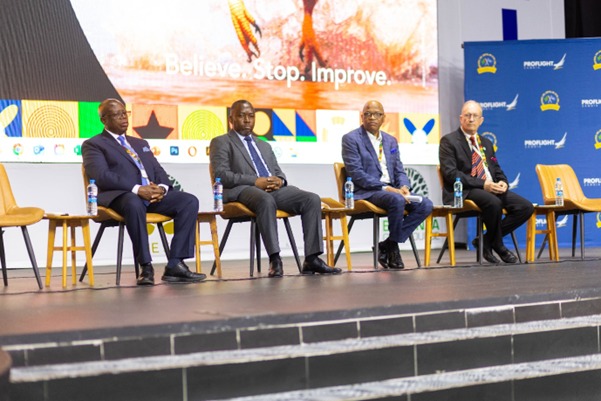
Airbus’s Mr. Joep Ellers addressed a panel discussion on engaging Original Equipment Manufacturers (OEMs) for Constructive feedback at the Airline Association of Southern Africa (AASA) conference held at Ciela Resort. He opened it with that figure, letting it linger and daring anyone to challenge it. Airlines elsewhere routinely exceed twelve hours of daily utilisation, doubling productivity with the same machinery, the same sky, and often tougher competition. Silence followed and it was not of disbelief, it was recognition. Everyone knew the truth but had stopped reacting.
Mr. Dominique Dumas of Regional Transport Airlines (ATR) was explaining turboprops and fuel efficiency when the conversation shifted from engines to economics, from theory to survival. What does it mean when aircraft built to move spend most of their lives on the ground?
Moderating the panel, Mr. Getaneh Woldemichael asked manufacturers to provide constructive feedback on African aviation. Which habits hold the sector back? What should airlines stop doing? Rather than diplomatic responses, what emerged was an itemised list of decisions that make no economic sense.
Machinery Built to Move Fast-becoming a Collection of Artefacts
Mr. Jurjan Knol, Vice President of marketing at Embraer, mentioned that under 300 of his company’s aircraft operate across Africa. Utilisation rates lag far behind other regions by marginal differences and gaps suggesting fundamental operational flaws.
Every grounded hour carries a bill: debt payments continue, insurance premiums accrue, hangar fees mount, and salaries demand payment—all while aircraft earn nothing.
Industry expert and former CEO of T-Bird Africa, Mr. João Pó Jorge, summarised the hidden conclusion: at five to six hours daily, economies of scale become impossible. No one makes money and sustainability is unattainable when half the productive capacity remains idle by choice rather than necessity.
Mr. Knol added that regulatory environments often hinder growth. Airlines cannot expand beyond their fixed costs because rules designed to protect struggling national carriers prevent the competition needed for viability this leaves countries clinging to symbols while operational reality crumbles.
Selecting Wrong Tools for Simple Jobs
Mr. Dumas from Regional Transport Airlines (ATR) highlighted a simple but critical inefficiency: airlines deploy jets on routes barely 300 nautical miles long, where turboprops consume 50% less fuel. Such a difference is not a minor; it shows up immediately in profit and loss statements. Wrong choices reduce profits and eliminate the possibility of profit entirely.
Mr. Knol outlined a future already waiting on the tarmac: Embraer’s network of MROs and training centres, leasing partners ready to ease transitions to newer aircraft with fuel-efficient engines, lighter airframes, and smarter onboard systems. Yet many carriers remain loyal to ageing fleets that burn more, earn less, and keep Africa’s skies half-empty.
International Air Transportation Association (IATA)’s regional director added context: Africa’s fleet averages five years older than global standards. New aircraft orders are marginal—measured in tens, while other regions order in hundreds. Older aircraft require more maintenance, leading to longer downtime, lower utilisation, and destroyed profitability. One problem compounds the next until operations become unsustainable.
The Silent Runways
Mr. Jorge cited another striking statistic: only 18% of African airlines utilise operational safety training offered by insurance companies. Free or low-cost training sits idle and 82% ignore it.
Airbus’s Mr. Ellers outlined low-cost efficiency measures: single-engine taxi procedures, optimised airway routings, refined descent profiles. Airbus recently opened a support centre in Johannesburg to upskill local talent and build MRO and training partnerships. Skywise, their predictive maintenance system, exists to help airlines maximise utilisation.
Modern aircraft and infrastructure exist in Africa but what remains is the willingness to seize it.
Pride That Costs More Than It Is Worth
Mr. Jorge strongly favours consolidation, arguing that the notion of national flag carriers must end. Small nations maintain airlines for prestige, not profitability. Fixed costs crush these ventures immediately, and no government subsidy creates genuine sustainability when fundamental economics are hostile.
Ethiopian Airlines serves as proof: one strong carrier can serve a region better than a dozen weak ones. Pooled resources enable better training, more efficient maintenance, stronger negotiating positions, and economies of scale. Yet countries prefer symbols to substance. Regulatory frameworks protect failing national carriers, preventing consolidation and competitive African airlines. Political priorities override economic reality until no economic reality remains.
Training is an investment, not a cost, Mr. Jorge emphasised. Cultural and management training matter as much as technical skills. OEMs offer programmes, but airlines treat them as optional luxuries. Massive shortages of trained pilots, mechanics, and managers loom within ten to fifteen years. Africa can prepare now or face a crisis later. Airbus’s Johannesburg support centre and Embraer’s regional training facilities exist to address this gap.
Why do 82% of airlines ignore training that could prevent disasters, improve operations, and save money? The silence at the panel suggested a question of priorities rather than availability.
Grounded by Hesitation or Lifted by Action
Air traffic to and within Africa is projected to double in the next twenty years, requiring nearly 1,500 new passenger aircraft. Demand will rise regardless of African readiness, and trends suggest foreign carriers might serve passengers more efficiently.
Financing is not the missing piece. Embraer supports operators through Brazil’s development bank (BNDS), Airbus maintains regional partnerships, and ATR tailors solutions for smaller operators. Scaffolding for growth exists, but no structure stands without a foundation, a business plan needs to be grounded in reality.
When asked what African airlines must stop doing, the panel’s responses were unambiguous: low utilisation when aircraft should be flying, jets on routes suited for turboprops, ignored training, resisted consolidation, six-month repair waits instead of six weeks, and national pride prioritised over commercial viability.
Financing, training, and support exist. Manufacturers made it clear that Africa’s aviation future depends on internal decisions. Ethiopian Airlines demonstrates what becomes possible when economics take priority. Now the choice lies entirely with the airlines themselves: seize the opportunity or watch growth flow to better-run foreign competitors.