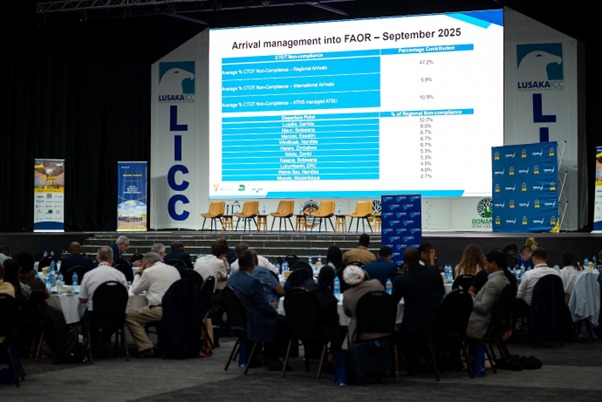
Esther Nachula, Ciela Resort and Spa, Lusaka | 12 October 2025 — An airline pays $4,998 to turn around an Airbus A320 carrying 170 passengers in Doha. The same operation costs $35,000 in Nigeria. This staggering disparity, presented at the 2025 AASA conference in Lusaka, reveals why African aviation bleeds money despite outpacing global growth rates. The continent contributes $75 billion to GDP and supports 8.1 million jobs, yet airlines operate in a high-cost prison of their own governments' making. Jet fuel costs more. Taxes pile higher. Safety records lag dangerously behind, with 10.5 accidents per million flights compared to the global average of one. Industry leaders gathered in Zambia identified the missing stakeholder with precision: Ministers of Finance hold the power to reduce charges and remove non-aviation taxes, but they never attend these discussions.
The Mathematics of Failure
Speaking at Airlines Association of Southern Africa (AASA) 2025 Conference, Kamil Al-Awadhi, IATA's Vice President for Middle East and Africa, laid bare the numbers that explain why African carriers struggle to survive. Beyond the Nigerian example, Kenya charges $9,700 for the same aircraft turnaround that costs $5,160 in South Africa. Tanzania applies a $45 passenger information charge where the global average hovers around $2.
"The level of intelligence we have in this room is incredible," Al-Awadhi told conference attendees. "IATA's number one cargo expert is African. IATA number one ANSP expert is African." He paused before delivering his challenge: "Demand today that we work with governments in 2026 to improve the safety standards in Africa and demand from the three [associations] that we improve the level of safety and we lower the costs in Africa. Push us to do it, literally push us to do it."
Aaron Munetsi, CEO of AASA, framed the absurdity in stark terms. "Matter of fact, IATA tells us that actually it costs more to buy a cup of coffee than to fly a passenger on the African continent," he said. The statement drew uncomfortable laughter from the audience, recognition of an economic reality that defies logic. Airlines operate on margins so thin they effectively subsidise passenger movement while governments extract fees that would bankrupt carriers in wealthier markets.
The cost structure creates perverse incentives throughout the system. Mr. Abderahmane Berthe, Secretary General of the African Airlines Association, pointed to the root cause. "The African GDP per capita is on average 15 percent of the world average in some regions," he explained. Yet instead of reducing barriers to affordable travel in economies where citizens can barely afford tickets, governments pile on charges. "I think government should really do their best to reduce taxes and charges level across the continent," Mr. Berthe urged, his frustration evident after years of raising the same issue without resolution.
When Ministers Talk to the Wrong Ministers
Perhaps the most striking revelation from the conference came from the absent solution-makers. Every speaker returned to the same missing piece: Ministers of Finance. Transport ministers understand the crisis. Aviation experts produce comprehensive reports. Airlines present detailed cost comparisons. Yet the people who control tax policy and budget allocations never join these conversations.
Ms. Chikondi Nsusa from the SADC Secretariat articulated the frustration. "I feel like this group here is convinced. Even if we talk to the ministers of transport, they are convinced. But who exactly do we need to talk to? Maybe that is the thing that we need to really address." Her proposal cut through years of circular discussions: form technical working groups that bypass the ceremonial ministerial meetings and engage directly with individual Ministers of Finance in member states. "Rather than have a 30-minute meeting for ministers who just endorse everything," she said, the region needs sustained deliberation with the people who actually write budget policy.
Mr. Berthe reinforced this point with unusual directness. "What I will recommend is to involve also the ministers of finance because the challenge is that the ministers of transport alone cannot make this kind of decision." The statement acknowledged what everyone in the room already knew: aviation policy fails when the people who understand aircraft do not speak to the people who understand money.
Proof That Change Remains Possible
But success stories do exist. Stephen Musa, an expert with the African Civil Aviation Commission (AFCAC), delivered news that electrified the conference room. "[The Economic Community of West African States] ECOWAS heads of state adopted a decision in February 2025 to remove four taxes that are not related to aviation out of the tickets and they have also agreed to reduce charges by 26 percent effective January 2026," he announced.
AFCAC has spent years documenting the damage caused by excessive taxation. Their compendium report, validated in September, waits for adoption by ministers in December. Musa emphasised that the ECOWAS breakthrough offers a template for other regions. "We are working with the sub-regional groups to see how they can domesticate their market," he explained. Market domestication addresses regulatory fragmentation and eliminates the costly Foreign Carrier Operator Permit requirements that treat African airlines as foreign entities within their own continent.
Zambia's Permanent Secretary for Transport and Logistics, Fredrick Mwalusaka, accepted the challenge to lead SADC's implementation efforts. His personal experience illustrated the absurdity of current arrangements. "I had to fly back all the way into South Africa, spend the night in South Africa, fly over Zambia to get to Lubumbashi the following morning," he recounted. "I think we can do better than that. We need a connected Africa that has opened skies." His government has committed to championing market domestication within SADC, starting with the five KASA states.
Safety Cannot Wait for Bureaucracy
While cost structures damage profitability, safety statistics threaten lives. Al-Awadhi refused to soften his assessment. "If you think we are safe in Africa, we are not. The average accident on planet Earth is about one accident per million flights. In Africa is about 10.5 accidents per million flight." He placed blame squarely on institutions. "I hold ICAO responsible for their poor performance and I hold nearly all the civil aviations in Africa also responsible for their poor performance."
Mr. Munetsi added operational examples that made the safety crisis tangible. "Our air traffic navigation system is really dropping the ball," he said, noting that "access to one of our major tourist destinations in South Africa, Kruger National Park and Malanga, is inaccessible because the instrument flight procedures are not functional." Airlines cannot safely fly routes where the ground infrastructure fails to meet basic standards.
Africa outpaces every other region in aviation growth yet remains the least profitable and least safe airspace on the planet. Nineteen countries have joined the Single African Air Transport Market pilot program launched in Lusaka in August 2025. Reports sit validated and ready for implementation. The intelligence to solve these problems resides in African experts already working at the highest levels of global aviation organisations.
What remains missing are actual, direct meetings with Ministers of Finance. Until those conversations happen, airlines will continue paying seven times more to land the same plane, passengers will sleep in foreign airports to reach neighbouring countries, and the $75 billion contribution to African GDP will remain far below its potential. The conference participants left Lusaka with three commitments: activate working groups through SADC to domesticate the Single African Air Transport Market, hold governments accountable for improving aviation facilities, and speak directly to Ministers of Finance about taxes and charges. October 2026 will reveal whether these promises produce different results than decades of prior recommendations.